Speaker Series
ACTOR Speaker Series
The ACTOR Speaker Series invites world-class scholars to share their research on topics related to timbre and orchestration to the general public. The presentation series is either in-person in a hybrid format or is virtual, so that members and guests have the opportunity to exchange ideas and participate in the Q&A session following each presentation. When possible, to maximize dissemination of information, video recordings documenting the event are made available on ACTOR’s website.
For more info details about ongoing series, follow these links:
Upcoming Events
Past Events
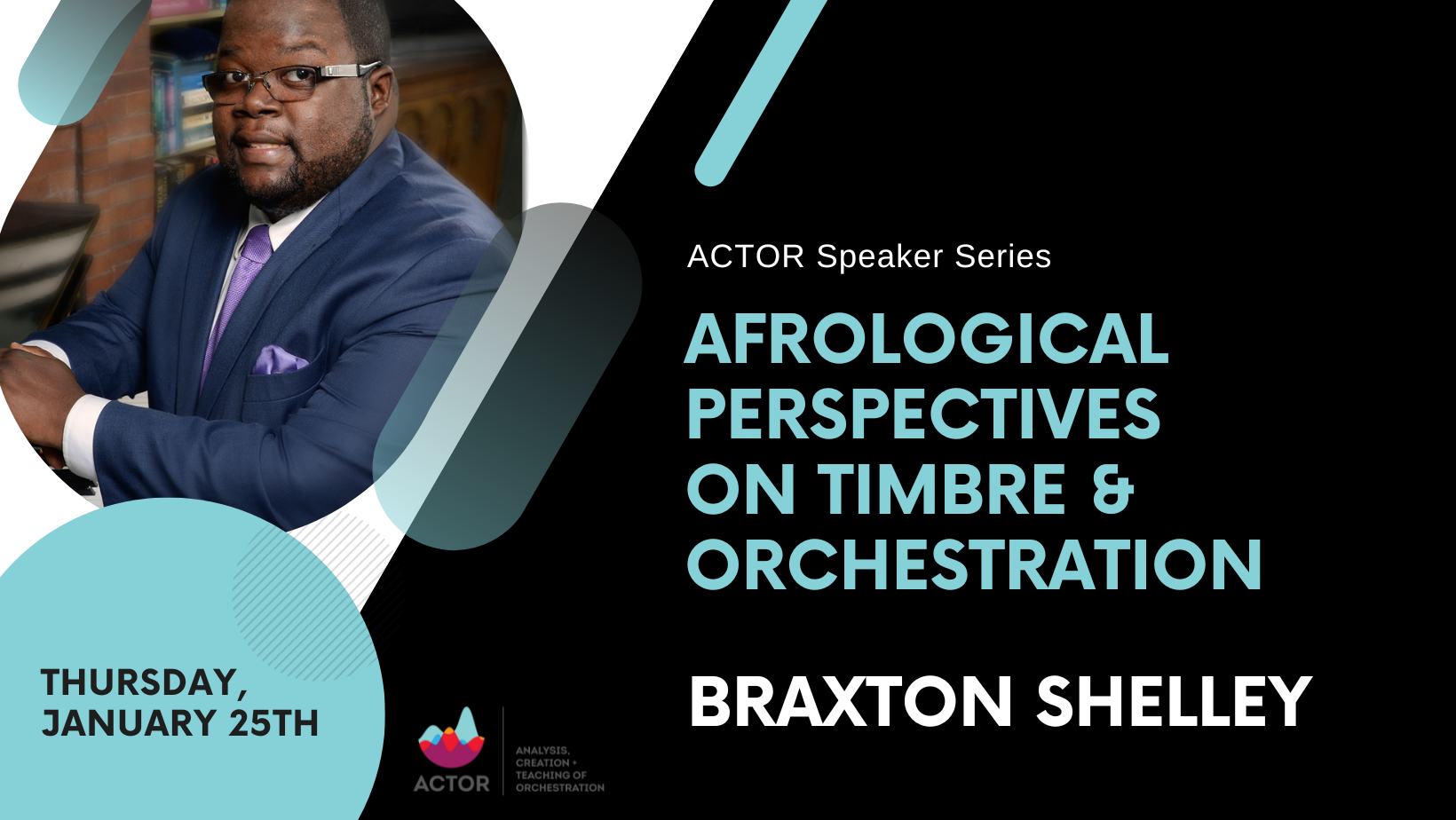
Minister, musician, and musicologist Braxton D. Shelley is a tenured associate professor of music, of sacred music, and of divinity in the Department of Music, the Institute of Sacred Music, and Yale's Divinity School. A musicologist who specializes in African American popular music, his research and critical interests, while especially focused on African American gospel performance, extend into media studies, sound studies, phenomenology, homiletics, and theology. Shelley is the author of Healing for the Soul: Richard Smallwood, the Vamp, and the Gospel Imagination as well as the forthcoming An Eternal Pitch: Bishop G.E. Patterson and the Afterlives of Ecstasy. His research has received considerable recognition including the Alfred Einstein Prize, Paul A. Pisk Prize, the Jaap Kunst Prize, and the Adam Krims Award. He received his Ph.D. in the History and Theory of Music at the University of Chicago.

Ayò Olúrántí is a composer, conductor, organist, and music theorist specializing in pre-colonial Yorùbá music and culture. Equally fluent in the fields of production and computer technology, he is also an active member of the digital and virtual pipe organ community. His cross-cultural approaches to composition and scholarship have earned him considerable international attention. He has performed and composed in Nigeria, the UK, the USA, South Africa, and Germany. Olúrántí is the recipient of numerous prestigious awards including the Morehouse College Sub-Sahara Africa Commission Award, Andrew Mellon Pre-Doctoral Fellowship, and was the winner of the Donald Sutherland Endowment Fund Composition Competition. He has published research on tonality of African languages, polyrhythm in African pianism, intercultural music composition, and orality as a compositional technique. Olúrántí received his Ph.D. in Composition & Theory from the University of Pittsburgh.

This talk will consider how the timbre of string band music has been racialized through the legacy of blackface, while recovering some of the performed histories (past and present) of Black string band musicians.

Combining original compositions and traditional Haitian tunes with historical broadcasts and contemporary interviews, Leyla McCalla’s remarkable new album, Breaking The Thermometer, offers an immersive sonic journey through 50 years of racial, social, and political unrest as it explores the legacy of Radio Haiti—the first radio station to report in Haitian Kreyòl, the voice of the people—and the journalists who risked their lives to broadcast it.

The Sub-Saharan Africa/Diaspora Subgroup of the Analysis, Creation and Teaching of Orchestration (ACTOR) project and the Centre for Interdisciplinary Research in Music Media and Technology (CIRMMT) invite all for the sixth talk of the Speaker Series: Afrological Perspectives on Timbre and Orchestration. Presented by Joel Smith (Tufts University).

The East Asian Music subgroup will organize a finishing guest talk on Mar. 23rd for this term, inviting German composer, Prof. Claus-Steffen Mahnkopf (Hochschule für Musik und Theater “Felix Mendelssohn Bartholdy” Leipzig) to talk about his recent composition “Zhōng” (2020) scored for traditional Chinese ensemble, a piece with extensive exploration on extended timbral possibility of different Chinese instruments and on notational practice.

The Sub-Saharan Africa/Diaspora Subgroup of the Analysis, Creation and Teaching of Orchestration (ACTOR) project and the Centre for Interdisciplinary Research in Music Media and Technology (CIRMMT) invite all for the fifth talk of the Speaker Series: Afrological Perspectives on Timbre and Orchestration. Presented by Andile Khumalo (University of the Witwatersrand, Johannesburg).
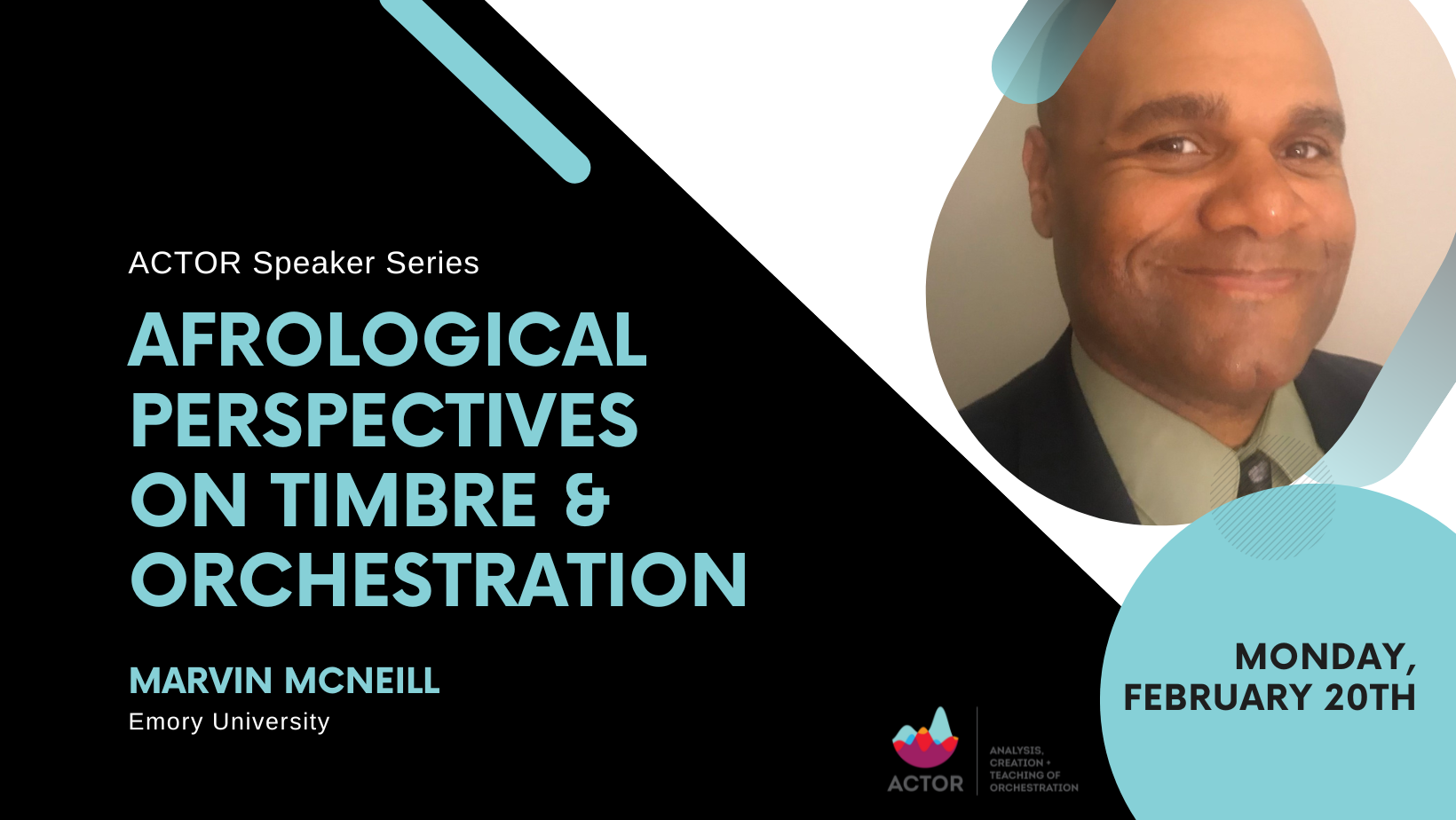
The Sub-Saharan Africa/Diaspora Subgroup of the Analysis, Creation and Teaching of Orchestration (ACTOR) project and the Centre for Interdisciplinary Research in Music Media and Technology (CIRMMT) invite all for the fourth talk of the Speaker Series: Afrological Perspectives on Timbre and Orchestration. Presented by Marvin McNeill (Emory University)

The Sub-Saharan Africa/Diaspora Subgroup of the Analysis, Creation and Teaching of Orchestration (ACTOR) project and the Centre for Interdisciplinary Research in Music Media and Technology (CIRMMT) invite all for the third talk of the Speaker Series: Afrological Perspectives on Timbre and Orchestration. Presented by Kevin C. Holt (Stony Brook University, SUNY)

The Sub-Saharan Africa/Diaspora Subgroup of the Analysis, Creation and Teaching of Orchestration (ACTOR) project and the Centre for Interdisciplinary Research in Music Media and Technology (CIRMMT) invite all for the second talk of the Speaker Series: Afrological Perspectives on Timbre and Orchestration. Presented by Dr. Stephanie Shonekan (University of Maryland)
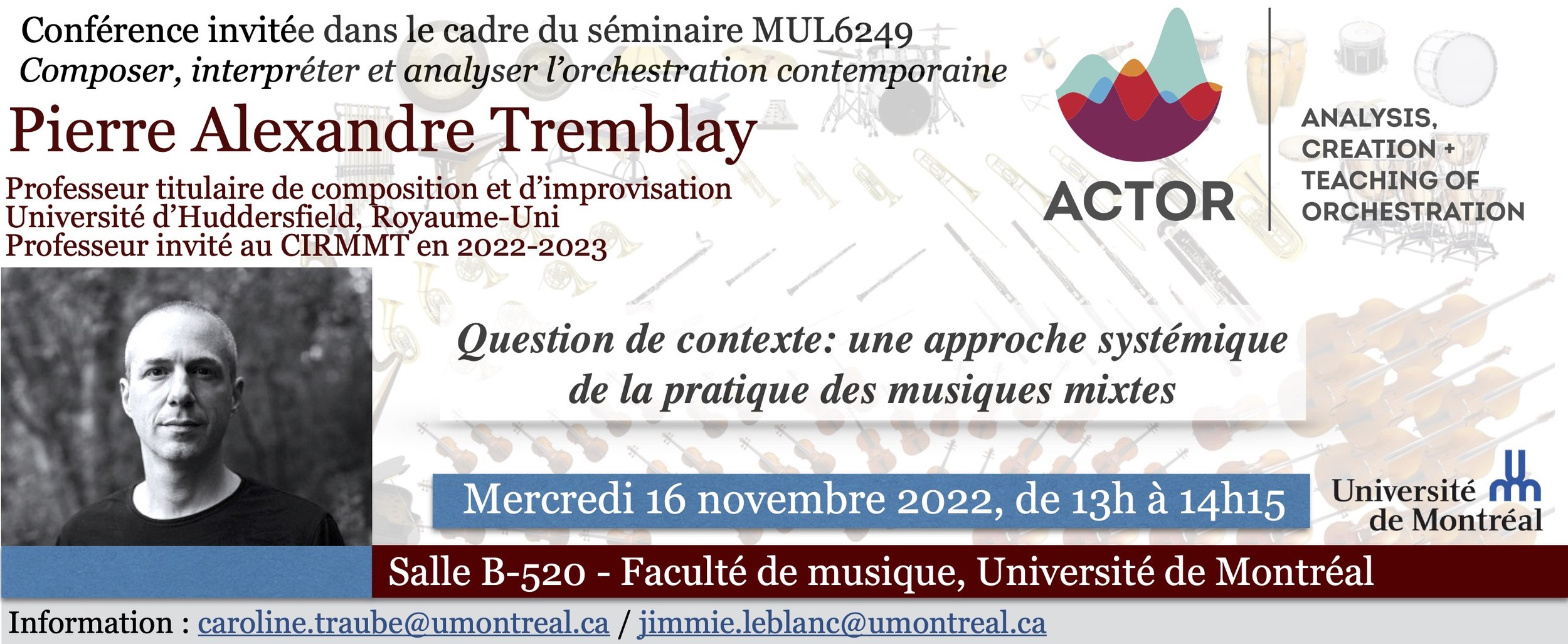
Qu’arrive-t-il lorsqu’on considère l’écosystème de la pratique des musiques mixtes dans toute sa richesse et sa complexité? Quelle dynamique existe-t-il entre l'idéation, l'interprétation, les techniques informatiques et instrumentales comme orchestration, entre leurs limites, leurs affordances, et les goûts et intérêts des différentes communautés qui pratiquent ces musiques?

The Sub-Saharan African and Afro-Diasporic subgroup of the Diversity working group are pleased to formally announce the Speaker Series: Afrological Perspectives on Timbre and Orchestration. The series, spearheaded by Jason Winikoff, Joshua Rosner, and Jay Marchand Knight, will take place over the 2022-23 academic year and will launch with a talk by Dr. Bibian Kalinde.